AI Email Deliverability Advice Is Wrong — And It's Getting People Burned
AI deliverability reports sound expert but are dangerously wrong — invented throttle rates, bad IP advice, and false confidence. A 20-year expert breaks down the six worst mistakes.


On this page
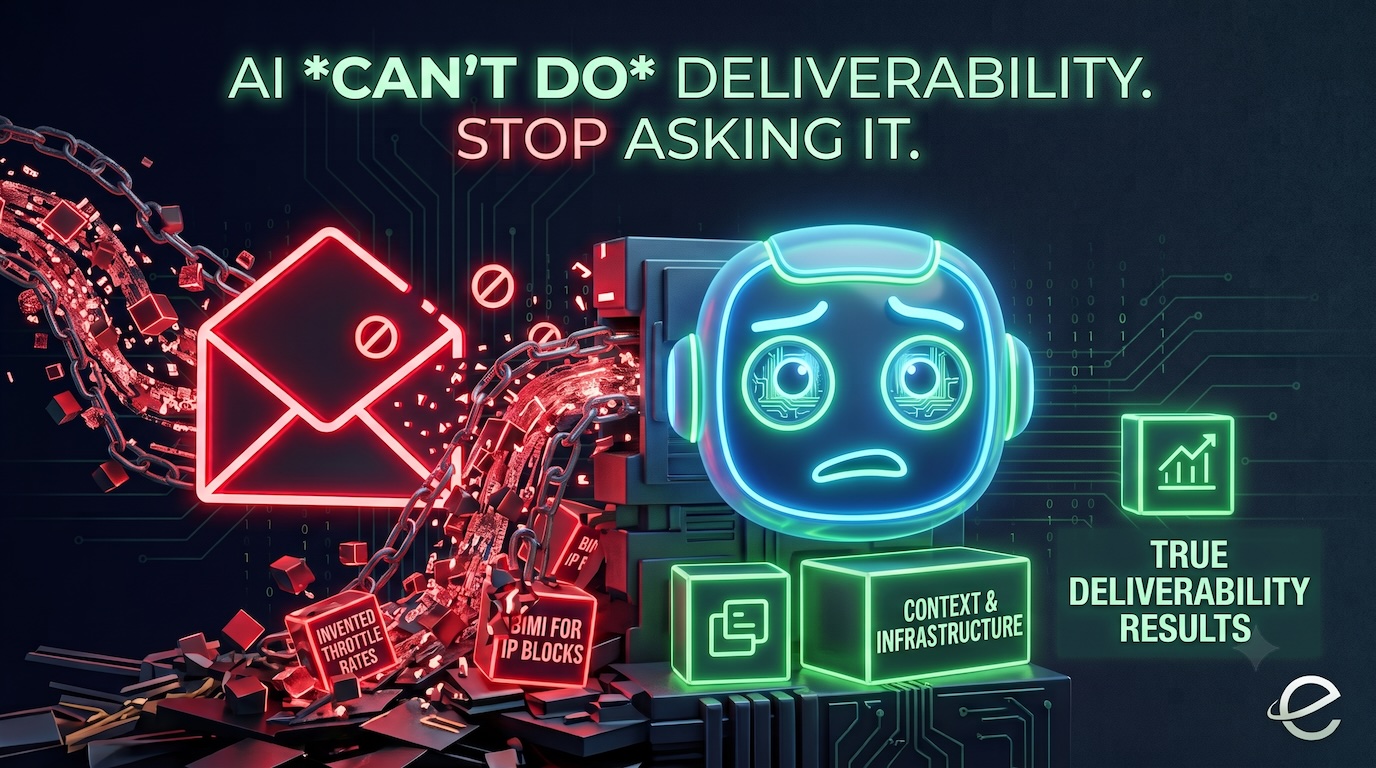
There's a growing problem in AI email deliverability advice, and it's not spam filters or iOS privacy changes. It's the people who just discovered they can paste a bounce log into ChatGPT and get an AI-generated deliverability audit back in 30 seconds.
I get it. It's tempting. You feed it some data, it spits back a wall of confident, technical-sounding recommendations, and suddenly you feel like you have a plan. The problem is that the plan is wrong, and you don't know enough to know it's wrong. That's not a dig. That's the whole point.
Why does AI get email deliverability wrong?
AI-generated deliverability reports consistently make six dangerous mistakes:
- Treating soft bounces as permanent failures
- Inventing throttle rates with no data basis
- Recommending new IP rotation without warming
- Prescribing BIMI for IP reputation issues
- Applying universal SPF
-allwithout infrastructure context - Suggesting cold outreach to enterprise IT for safelisting
Each of these can damage sender reputation if implemented as written. Here's why.
Why AI gets email deliverability wrong
LLMs aren't deliverability experts. They're pattern-matching machines trained on the internet, which means they've absorbed every surface-level "best practices" blog post ever written. They know what deliverability sounds like. They do not know what it is.
The result is output that reads like a senior consultant wrote it but falls apart the second you try to act on it. Specific throttle rates pulled from thin air. Authentication recommendations applied blanket-style with no understanding of your infrastructure. Confident assertions about how mailbox providers work that haven't been true since 2019.
For someone with no deliverability background, this creates something worse than confusion. It creates false confidence. You think you have expert guidance. You don't. You have a hallucination dressed up in technical jargon.
Real examples of bad AI deliverability advice
A client recently shared an AI-generated "deliverability report" they'd built by feeding bounce and failure data into ChatGPT. It came back as a polished, multi-section document with domain-level breakdowns, action checklists organized by team (Deliverability, Marketing, Engineering), and specific numeric recommendations for throttle rates and retry windows.
It looked impressive. It was full of bad advice. Here are the six worst offenders.
1. Why AI treats soft bounces as permanent failures
The report flagged temporary conditions — 4.2.2 mailbox-full errors, 4.7.1 IP reputation deferrals, 452 quota responses — as permanent failures requiring immediate suppression. A recipient whose Gmail inbox was temporarily over quota? Purge them. An IP deferral from a blocklist provider that would resolve after a delisting request? Suppress the whole domain.
In reality, soft bounces are temporary. They mean "try again later," not "this address is dead." If you suppress every address that returns a 4.x code, you're permanently removing valid, engaged subscribers over what amounts to a transient hiccup. That's how you shrink a healthy list into an unhealthy one while feeling like you're doing good list hygiene.
2. Why AI invents throttle rates
The report recommended specific per-domain sending limits — 30 per minute here, 50 per minute there, 80 per minute for Yahoo — with zero basis for any of those numbers. These weren't pulled from postmaster documentation or based on the sender's actual volume and reputation. They were made up. Confidently.
The danger isn't that the numbers are slightly off. It's that someone will implement them as gospel and either throttle so aggressively they can't get their mail out, or assume they've "fixed" their sending rate when the real problem is something else entirely.
3. Why AI recommends new IP rotation without warming
The report suggested immediately moving traffic to a new, dedicated IP pool. This is one of the most dangerous pieces of advice in deliverability, and AI gives it constantly because it sounds logical on paper. In practice, a brand-new IP has no reputation. Not a good one. A nonexistent one. If you shift significant volume to an unwarmed IP, you're going to get blocked everywhere, not just at the domains that were already giving you trouble.
If you're actually moving to a new IP pool, you need a proper IP warming schedule — not a cold switch.
4. Why AI prescribes BIMI for IP reputation issues
One section recommended publishing a BIMI record as part of remediating IP-level blocks. BIMI is a logo standard. It has absolutely nothing to do with IP reputation. This is the AI equivalent of telling someone to change their profile picture to fix a flat tire.
5. Why AI suggests universal SPF -all without infrastructure context
The report recommended switching to SPF -all across the board. Sounds secure, right? In many real-world sending environments, flipping to -all without understanding every system that sends on behalf of your domain will break legitimate mail flows. The AI doesn't know your infrastructure. It just knows that -all is the "strict" option, and strict sounds better.
6. Why AI recommends "Contact IT" at receiving organizations
Multiple sections recommended reaching out to the IT departments at hospitals, universities, and enterprises to request safelisting. This advice technically isn't wrong, but it's wildly impractical. Most of these organizations won't respond to cold outreach from a sender they've never heard of asking to be whitelisted. This is the kind of recommendation that sounds actionable in a report and goes absolutely nowhere in practice.
Want a diagnostic you can actually trust? Grab the free 27-point deliverability checklist — the same framework I use with every new client, before anyone implements ChatGPT's advice.
Why AI can't do real deliverability work
The AI isn't lying. It's doing exactly what it was designed to do: produce plausible-sounding text based on patterns in its training data. The problem is that email deliverability is a field where the difference between right and almost-right can mean the difference between the inbox and the spam folder, or between keeping your sender reputation and torching it.
Real deliverability work requires understanding context that an AI simply doesn't have:
- Your specific sending infrastructure. What IPs, what ESPs, what authentication is already in place, what shared vs. dedicated, what volume patterns.
- Your relationship with mailbox providers. Whether you're enrolled in feedback loops, postmaster tools, and SNDS. What your complaint rates actually are, not what they "should" be.
- The history. Was this IP warm six months ago and degraded, or is it brand new? Did you recently change ESPs? Did your list source change? Context matters enormously and AI has none of it.
- The politics. Which recommendations are actually implementable given your team, your tech stack, and your organizational reality. A technically correct recommendation that no one can execute is worthless.
An AI can't call your ESP. It can't log into your postmaster tools. It can't look at your actual complaint rates and bounce trends over time. It can't tell you that the advice it's giving you contradicts what it told someone else yesterday, because it doesn't remember yesterday.
The false confidence problem with AI deliverability
This is what worries me most. When someone with limited deliverability experience gets a detailed, authoritative-sounding report from an AI, they believe it. Why wouldn't they? It uses the right terminology, it's organized into clear sections, it gives specific action items. It looks like expertise.
But expertise isn't knowing the vocabulary. It's knowing when the standard advice doesn't apply, that "warm your IPs" means something different for a sender doing 50K/day versus 5M/day, that some ISPs actually respond to delisting requests and others require you to fix the underlying problem first. It's the difference between recognizing a recommendation and knowing whether it's about to make things worse.
AI doesn't have that judgment. It has pattern matching. And pattern matching will get you a report that looks right and is wrong in ways you can't detect until you've already done the damage.
What to do instead of using AI for deliverability
I'm not anti-AI. I use AI tools every day. They're great for drafting content and summarizing data. But email deliverability is a domain where generic advice is actively dangerous and the details matter more than the framework. The cost of being confidently wrong is lost revenue and damaged sender reputation.
If you're using AI to generate deliverability recommendations, you need an email deliverability consultant who actually knows the space to review them. Not to check the formatting. To check whether any of it is true.
And if you're relying on AI instead of a deliverability expert, you're not saving money. You're just finding out what goes wrong more slowly.
Frequently asked questions
Can ChatGPT do email deliverability?
No. ChatGPT can produce text that sounds like deliverability advice, but it lacks the three things real deliverability work requires: visibility into your specific sending infrastructure, access to postmaster tools and reputation data, and the judgment to know when standard advice does not apply. It is useful for drafting and summarizing, not for diagnosing sender reputation problems.
Is AI reliable for technical email advice?
AI is reliable for general education — explaining what SPF is, what a soft bounce means, how DMARC alignment works. It is not reliable for prescriptive advice on your specific environment, because it cannot see your environment. Treat AI output as a research starting point, never as a remediation plan.
What does a deliverability expert do that AI can't?
A deliverability expert can log into your ESP and postmaster tools, read your actual complaint and bounce trends, contact mailbox provider representatives, interpret IP and domain reputation in context, and prioritize fixes based on what your team can actually execute. AI can do none of this.
Why do AI-generated deliverability reports look so convincing?
Because LLMs are trained on thousands of deliverability articles and know the vocabulary, structure, and tone of expert writing. They produce output that matches the shape of an expert report without the underlying diagnostic judgment. This is exactly why they are dangerous for inexperienced readers — the report looks right even when the recommendations would damage your sender reputation.
Should I ever use AI for email deliverability?
Yes, carefully. AI is genuinely useful for writing subject line variations, drafting pre-send QA checklists, summarizing long postmaster documentation, and turning technical diagnoses into stakeholder-friendly language. Avoid using it to generate remediation plans, throttle rates, authentication changes, or IP strategy without expert review.
Tom Sather has worked in email deliverability for over twenty years. He has led deliverability teams at global ESPs, advised Fortune 500 senders on reputation recovery, and spoken at industry events including M3AAWG. He runs Email Lookout, a deliverability consulting practice, and writes about inbox placement, authentication, and sender reputation. Connect with him on LinkedIn.
Think your deliverability might need a human set of eyes? Book a free 30-minute assessment.
Tom Sather
Email deliverability expert with 20+ years of experience helping companies improve inbox placement and authentication. Founder of Email Lookout.
Need help with deliverability? Book a free assessment →Related Posts
Ready to Improve Your Email Deliverability?
Get a free assessment of your email authentication setup and actionable recommendations to boost your inbox placement.